
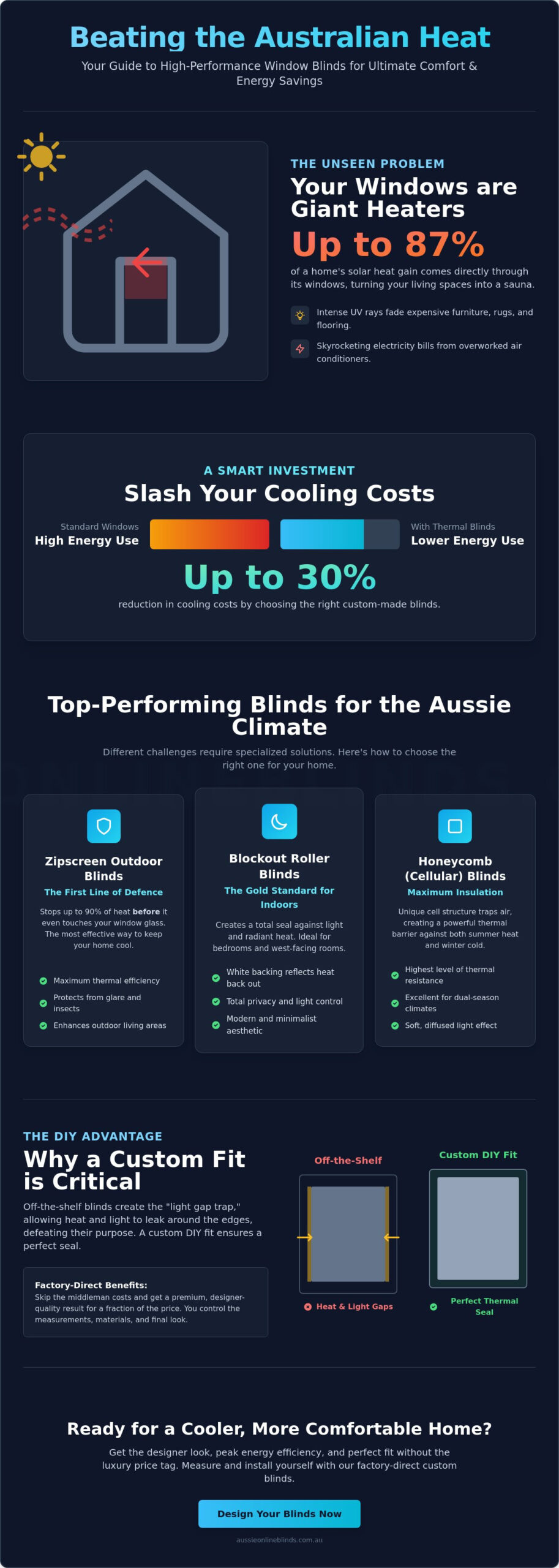
Your windows are essentially giant heaters, responsible for nearly 87% of the solar heat gain that turns your living room into a sauna every afternoon. We’ve all been there, watching the air conditioner struggle while the UV rays slowly bleach the life out of your expensive rugs and floorboards. It’s a frustrating cycle that makes your home feel uncomfortable and your electricity bills feel impossible.
Finding the best blinds for Australian climate doesn’t have to be a guessing game or a budget-breaker. We’re here to show you that achieving year-round thermal comfort and a high-end, modern look is completely doable on your own. By choosing the right custom-made materials, you can slash your cooling costs by up to 30% and meet the latest NCC 7-star energy requirements with ease. It’s about getting that premium, factory-direct quality without the unnecessary middleman costs.
In this guide, we’ll walk you through the top-performing fabrics for 2026, explain the mandatory safety standards for rental properties introduced in December 2025, and prove why DIY is the most practical path to a beautiful, energy-efficient home. You’ll learn exactly how to measure and select window treatments that stand up to the harshest sun while giving your space a seamless, designer finish.
Key Takeaways
- Learn why stopping solar radiation before it hits your window is the most effective way to keep your home cool and comfortable year-round.
- Discover how to identify the best blinds for Australian climate by looking for solution-dyed fabrics that resist fading and UV degradation.
- Understand the “light gap” trap and why custom DIY measurements are the key to blocking out heat and maintaining privacy.
- Explore how our factory-direct model helps you skip the middleman and achieve a designer look without the luxury price tag.
- Find out which specific treatments, like Zipscreen outdoor blinds or blockout rollers, are best suited for your home’s orientation.
Understanding the Australian Climate Challenge for Windows
Windows are often the weakest link in your home’s insulation. They act as the primary source of heat gain, accounting for up to 87% of a home’s heat transfer during the peak of summer. In our sun-drenched country, your choice of window coverings is the difference between a cool sanctuary and a sweltering living room. Finding the best blinds for Australian climate means understanding that our UV index is significantly higher than in Europe or North America. This intense radiation is a relentless force that quickly degrades standard fabrics not built for our local conditions.
Off-the-shelf blinds from big-box retailers might look fine in a showroom, but they rarely survive the reality of an Aussie summer. Most budget options fail within 2 to 3 years because they use low-grade PVC or polyester that turns brittle and yellows under 40-degree heat. To get a result that actually lasts, you need specialized, custom-made materials. Whether you are researching different kinds of window blinds for a new build or a renovation, the focus must be on durability and precision fit.
Australia’s massive size means we deal with vastly different environmental needs depending on where you live. Homeowners should consider these regional factors:
- Climate Zone 1 (Tropical): You need a balance of airflow and deep shade to manage high humidity and intense vertical sun.
- Climate Zone 5 (Temperate): Your windows require dual-season insulation to trap heat during chilly winters and block it during dry, hot summers.
- Arid Regions: High-performance blockout materials are essential to stop extreme radiant heat from baked-out landscapes.
Heat Gain vs. UV Protection: Know the Difference
It is easy to confuse these two, but they are different challenges. Heat comes from infrared light, which vibrates molecules and raises indoor temperatures. UV rays are the silent culprits behind your faded sofa and cracked floorboards. A blind can block out the light and still let in massive amounts of radiant heat if the material isn’t engineered correctly. This is where the Solar Heat Gain Coefficient (SHGC) matters. It measures how effectively a product blocks heat from the sun; the lower the number, the better your home performs during a February heatwave.
The Impact on Your Energy Bills
Investing in high-quality thermal barriers isn’t just about style. It’s a smart financial move. The right blinds can reduce your reliance on air conditioning by up to 30%, which puts money back in your pocket every month. When you install your own custom blinds, you ensure a tight fit that eliminates the gaps where heat leaks in. Thermal resistance is the capacity of a window covering to resist the flow of heat, keeping your indoor temperatures stable regardless of the weather outside.
Best Indoor Blinds for Thermal Control and Privacy
While outdoor solutions stop the sun early, your indoor treatments are the final barrier between sun-baked glass and your living space. If you’re looking for the best blinds for Australian climate, precision is your best friend. Even a tiny 5mm gap on the sides of a blind can lead to “light bleed” and allow heat convection to ruin your cooling efforts. This is why custom measurements are so critical. You want a seamless fit that hugs the window frame perfectly. For a deep dive into the different styles available, our guide on indoor roller blinds covers everything you need to know about modern interior styling.
Blockout Roller Blinds: The Gold Standard for Heat
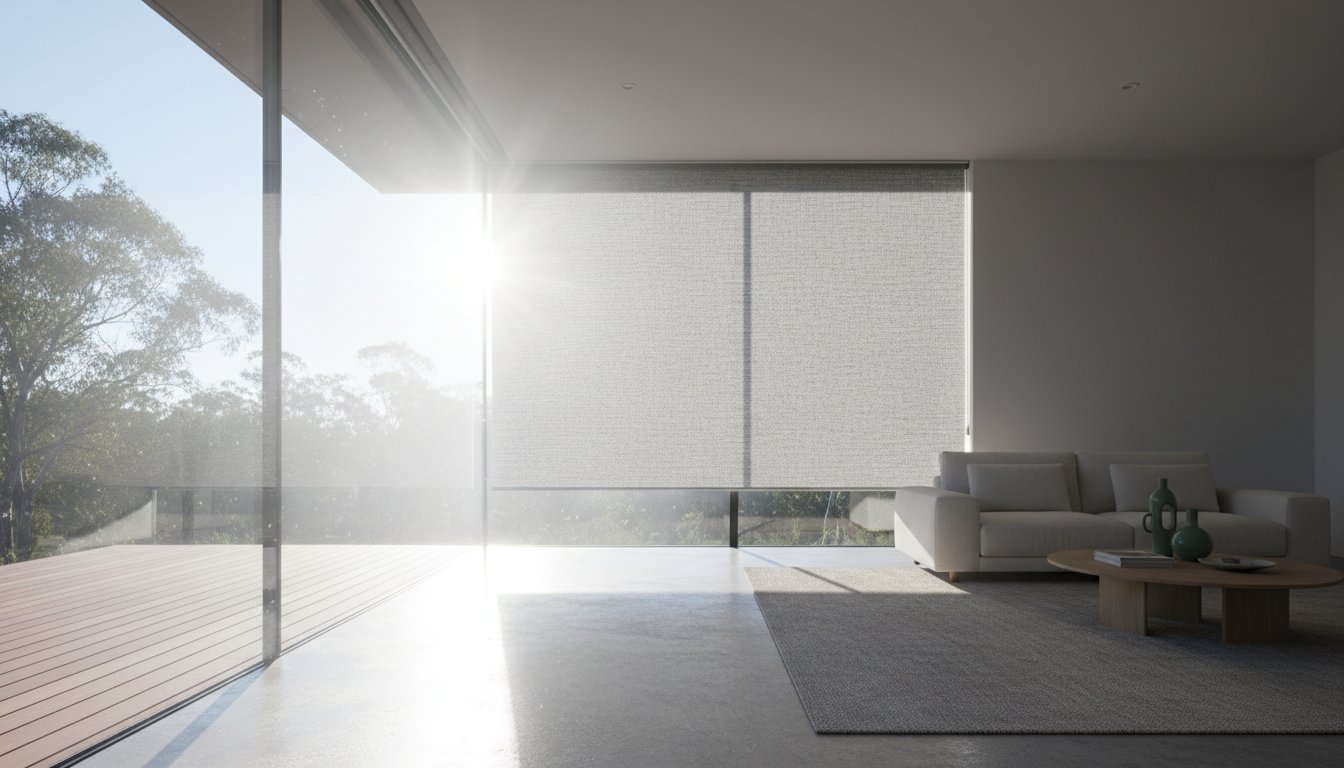
When the afternoon sun hits those West-facing windows, you need a serious solution. Blockout roller blinds are designed to create a total seal against light and radiant heat. We recommend choosing fabrics with a white-colored backing. This clever design reflects solar energy back through the glass before it can warm up your room. It’s a simple, effective way to keep your bedrooms dark and your lounge rooms cool during a February heatwave. By choosing a custom fit, you ensure the fabric sits as close to the glass as possible, which maximizes its ability to keep the indoor temperature stable.
Honeycomb (Cellular) Blinds for Maximum Insulation
If you want the highest level of thermal resistance, honeycomb blinds are a fantastic choice. Their unique “cell” structure traps a layer of air inside the blind, creating an invisible thermal buffer. This works both ways. In summer, it keeps the heat out; in winter, it stops your expensive heater-warmed air from escaping through the glass. While single-cell blinds are great for mild climates, double-cell versions offer a much thicker barrier against the heat. They’re incredibly lightweight and fit snugly inside the window reveal, which helps eliminate those pesky thermal gaps that standard blinds often leave behind.
Sunscreen and Light Filtering: Managing Daytime Glare
You don’t always want to live in total darkness just to stay cool. Sunscreen blinds offer a brilliant “view-through” advantage. They cut out up to 95% of harsh UV rays, which is vital for preventing your timber floors and furniture from sun-bleaching. For the ultimate setup, consider a “Double Roller” solution. This combines a sunscreen blind for daytime glare and a blockout blind for night-time privacy. This is often the most practical choice for the best blinds for Australian climate because it handles the harsh midday sun and the need for evening privacy in one seamless system. If you’re ready to upgrade your home, you can browse our full range of custom options to find the perfect match for your space.
Outdoor Blinds: Stopping Heat Before It Hits the Glass
The smartest way to keep your home cool is to stop the sun before it ever touches your window panes. While indoor treatments are great for privacy and final insulation, outdoor blinds act as your first line of defense. They are remarkably efficient, reducing heat transfer by up to 90% compared to unprotected glass. By blocking solar radiation on the outside, you prevent the “greenhouse effect” from ever starting inside your rooms. When we look for the best blinds for Australian climate, these exterior powerhouses are often the most effective investment for slashing those summer energy bills.
Modern outdoor systems are built to thrive in our unique conditions. Whether you live in a breezy coastal spot dealing with salt air or a dusty inland town, today’s heavy-duty materials are designed to handle the pressure. Our custom-made solutions ensure that the fit is tight and the hardware is durable, providing a seamless look that adds genuine value to your property. Because you are measuring and installing them yourself, you get premium, factory-direct quality without the massive markup of a traditional retail showroom.
Zipscreen: The Ultimate Alfresco Solution
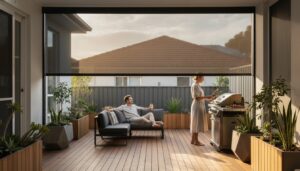
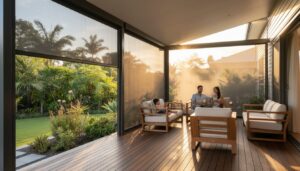
If you want to turn a patio or balcony into a year-round living space, zipscreen outdoor blinds are the gold standard. They use a clever “Side Lead” technology that locks the fabric into a side channel. This prevents those annoying rattles during a windy afternoon and eliminates gaps where heat or bugs might crawl through. Unlike cheap “straight drop” alternatives that flap around, a Zipscreen stays taut and secure. It creates a protected, bug-free environment that feels like a permanent room extension. It’s a practical, stylish way to maximize your home’s footprint while keeping the interior significantly cooler.
Pivot Arm Blinds for High-Circulation Areas
For second-storey windows or spots where you still want plenty of airflow, pivot arm blinds are a brilliant choice. These blinds project outward like an awning, creating a deep pocket of shade over the window while still allowing the glass to be open for a breeze. This “awning effect” is perfect for north-facing windows that get consistent sun all day. We use heavy-duty acrylic and canvas fabrics that are specifically engineered for high-exposure areas. They won’t sag or tear under the harsh Australian sun, and they provide a classic, high-end look that complements almost any architectural style. They are a tough, reliable option for homeowners who value both function and airflow.
Material Science: Choosing Fabrics That Last
The Australian sun is a relentless beast that can turn low-quality PVC or budget polyester into brittle dust in as little as 18 months. When you’re searching for the best blinds for Australian climate, the secret lies in the chemistry of the fabric itself. We always recommend looking for “solution-dyed” materials. Unlike cheaper fabrics where the color is simply printed on the surface, solution-dyed fibers have the pigment added while the polymer is still in a liquid state. This means the color goes all the way through the thread, much like a carrot rather than a radish, ensuring your blinds won’t fade into a patchy mess after a single summer.
Humidity is another factor that many homeowners overlook until it’s too late. In coastal regions or tropical zones, mold and mildew can take hold of damp fabrics overnight. Choosing materials with built-in antimicrobial properties is essential for longevity in these environments. You also need to consider the “Openness Factor” of your sunscreen fabrics. A 5% openness is the standard for a great view, but if you’re dealing with extreme heat, dropping to a 1% or 3% weave will provide a much tighter barrier against the sun’s rays while still maintaining your privacy.
UV Stabilisation and Fade Resistance
UV stabilisers are the unsung heroes of durable window coverings. These chemical additives prevent the polymer chains from breaking down when exposed to the high UV index levels, which often hit 14 or higher in Australian capital cities. Without these stabilisers, fabrics lose their flexibility and become prone to tearing. Color choice also plays a technical role; darker colors like charcoal are excellent for reducing glare on TV screens, though they do absorb more heat than lighter tones. High-quality 100% polyester with a multi-pass acrylic coating serves as the industry benchmark for Aussie blockouts because it ensures complete light opacity while preventing the fabric from curling or warping in 40-degree temperatures.
Maintaining Your Blinds in Dusty or Salty Air
Even the toughest fabrics need a little bit of love to survive decades in our environment. If you live within five kilometers of the ocean, salt crusting can seize up your outdoor hardware in less than a year. A simple rinse with fresh water every few months is usually all it takes to keep things moving smoothly. For indoor rollers, regular dusting is a must. When dust sits on a blind and is baked by the heat coming through the glass, it creates a “grime-bake” that is incredibly difficult to remove later. For more detailed tips on keeping your window treatments in top shape, check out our blind maintenance guide to protect your investment for the long haul.
Ready to upgrade your home with materials built for the local sun? You can shop our custom-made range today and get factory-direct quality delivered straight to your door.
The DIY Advantage: Custom Fit for Peak Performance
Many retail showrooms will tell you that a professional installer is the only way to get a perfect result. In reality, that “expert service” often hides a massive markup on labor and retail overheads that can add thousands to your renovation bill. By choosing a DIY approach, you’re not just saving money; you’re ensuring that you get the best blinds for Australian climate without the middleman. We believe that with the right guidance, any homeowner can achieve a high-end, seamless look that performs better than any off-the-shelf product. It’s about taking control of your home’s comfort and energy footprint with tools you likely already have in your garage.
The most significant enemy of thermal efficiency is the “light gap.” When you buy standard-sized blinds, you’re often left with 10mm or 20mm of exposed glass on either side. These gaps act like little chimneys, allowing hot air to circulate freely into your room even when the blinds are down. Custom-made means every millimeter is accounted for. Because our blinds are manufactured to your exact specifications, you get a tight seal that blocks out the sun and keeps your air conditioning inside where it belongs. Installation is surprisingly straightforward, usually requiring nothing more than four screws and a spirit level to get the job done.
Measuring for Success
Getting your measurements right is the foundation of a great result. We often recommend a “Face Fit” over a “Recess Fit” for maximum heat blocking. A Face Fit allows the blind to sit outside the window frame, overlapping the edges to eliminate those pesky light gaps entirely. If you prefer the look of a Recess Fit, you’ll need to be mindful of window handles or security locks that might obstruct the fabric. It’s a simple process once you know what to look for. You can follow our diy blinds guide for a clear, step-by-step walkthrough that ensures your order is spot-on the first time.
Ordering Online with Confidence
We’ve designed our online configuration tools to be as transparent as possible. You’ll see your exact price upfront as you select your fabrics and sizes, so there are never any hidden fees or “quote surprises” later on. Choosing the best blinds for Australian climate also means having peace of mind for the long term. That’s why we provide a 3-year Australian warranty on our custom-made range. As an Australian family-owned business, we understand the local conditions better than anyone else. We’re here to support you through every stage of your project, from the first measurement to the final screw, making sure your home looks stunning and stays cool for years to come.
Take Control of Your Home’s Comfort Today
Creating a cooler, more energy-efficient home is entirely within your reach when you select the best blinds for Australian climate. By stopping solar radiation with durable outdoor systems and sealing off internal heat with custom-made blockouts, you can maintain year-round comfort regardless of the temperature outside. Remember that precision measurements are the secret to eliminating those energy-draining light gaps that off-the-shelf products always leave behind. It’s about combining high-end material science with a simple DIY approach to get the best possible result for your space.
As an Australian family owned and operated business, we’re proud to offer factory direct savings that make premium window styling affordable for everyone. Every product in our range comes with a 3-year warranty, so you can install your new blinds with complete confidence. It’s time to stop letting the sun dictate your indoor temperature and start enjoying a more stylish, durable, and comfortable home. We’re here to help you every step of the way, ensuring your project is a success from the first measurement to the final screw.
Start your DIY journey and browse our custom-made range today!
Frequently Asked Questions
What is the best blind for blocking 100% of heat?
While no window covering can stop 100% of heat transfer, outdoor blinds are the most effective solution because they stop solar radiation before it touches the glass. High-quality Zipscreen or blockout roller blinds with a white-colored backing can reduce heat gain by up to 90%. This prevents the “greenhouse effect” where heat becomes trapped inside your home, making them a top choice for the best blinds for Australian climate.
Can I install outdoor Zipscreen blinds myself?
Yes, you can absolutely install Zipscreen blinds as a DIY project with basic tools and a bit of confidence. These systems are specifically designed for homeowners to install, with the complex side-lead technology pre-assembled for your convenience. All you need is a drill, a spirit level, and a helping hand to lift the blind into place. It is a straightforward process that avoids the high cost of professional tradespeople.
Do light or dark blinds reflect more heat?
Light-colored blinds reflect significantly more heat than darker shades. White or cream backings act like a mirror, bouncing solar energy back through the window to keep your rooms much cooler during summer. Darker blinds, such as charcoal or black, tend to absorb heat and radiate it into the room, though they are excellent for reducing glare on TV screens and computer monitors. For those setting up a productive home workspace, pairing these blinds with quality essentials from Mega Office Supplies ensures your office is as functional as it is comfortable. We recommend choosing a light-colored backing even if you want a dark interior fabric.
How long do custom blinds last in the Australian sun?
Custom-made blinds engineered for our local conditions typically last between 10 and 15 years. Unlike cheap off-the-shelf options that often become brittle or yellow within 2 to 3 years, our solution-dyed fabrics and UV-stabilized materials are built to withstand 40-degree temperatures. Regular maintenance and choosing the right material for your window orientation will ensure your investment stays functional and stylish for over a decade.
Are honeycomb blinds better than roller blinds for insulation?
Honeycomb blinds provide superior thermal insulation due to their unique “cell” structure that traps a layer of air. This air pocket creates a highly effective thermal buffer that works in both summer and winter to stabilize indoor temperatures. While blockout roller blinds are the gold standard for stopping light and radiant heat, honeycomb blinds offer a higher level of resistance against heat flow, making them ideal for temperate zones with cold winters.
What is the best way to clean outdoor blinds in coastal areas?
The best way to clean outdoor blinds near the ocean is a simple rinse with fresh water every 3 months. This prevents salt crystals from building up on the tracks and hardware, which can lead to corrosion or seizing over time. Avoid using harsh chemicals or high-pressure washers that can damage the fabric. A soft brush and mild soapy water are all you need to remove dust and salt spray, keeping your blinds looking new.
Will sunscreen blinds protect my furniture from fading?
Sunscreen blinds will protect your furniture and flooring by blocking up to 95% of harmful UV rays. These rays are the primary cause of sun-bleaching on timber floors and fabric upholstery. Because you can see through the mesh, you get to keep your view while ensuring your interior investments are shielded from the relentless sun. They are a practical daytime solution for any north-facing or west-facing room in your home.
How much can I save by choosing DIY blinds over professional installation?
You can save between $150 and $500 per blind by choosing the DIY route instead of professional installation services. On a standard home with ten windows, these savings quickly add up to thousands of dollars that stay in your pocket. By skipping the retail middleman and the labor fees, you get a premium, custom-made product for a much more affordable price. It’s the most cost-effective way to upgrade your home’s efficiency.