
Last Saturday, Sarah sat on her living room floor in Subiaco, staring at a $1,450 cart of custom window furnishings and wondering if she’d actually mastered how to measure for roller blinds. It’s a common moment of doubt. Nobody wants to spend their hard-earned Aussie dollars on a premium product only to find it’s 5mm too wide for the window frame. We agree that getting the numbers right feels like the most high-stakes part of your home makeover, especially when you’re trying to choose between a sleek recess fit or a practical face fit on an older, slightly uneven Australian timber frame.
The good news is that measuring your windows is a straightforward skill that anyone can master with the right guidance. This 2026 guide will give you the professional confidence to pick up your tape measure and secure a perfect fit, saving you upwards of $350 in specialist call-out fees. We’ll walk you through our proven step-by-step process for every window type, ensuring your new custom blinds look like they were installed by a pro without the high-end price tag. From handling wonky corners to choosing the right mounting style, we’ve got you covered.
Key Takeaways
- Learn the crucial difference between Recess and Face Fit mounts to choose the perfect aesthetic for your Australian home.
- Master exactly how to measure for roller blinds using our three-point check system to ensure a seamless, professional fit every time.
- Discover why using the smallest width measurement is the secret to avoiding installation headaches with inside-mount styles.
- Get expert tips on navigating common Aussie obstacles like window winders and tiles for a flawless, high-end DIY finish.
- Understand the “tight opening” measurement rule so you can order with confidence while we handle the technical deductions for you.
Getting Started: The Essential Tools and Choosing Your Mount Style
Measuring your windows might feel like a daunting task, but it’s the foundation of a professional, high-end look for your home. When you get the numbers right, your custom-made blinds will operate smoothly and look like they were installed by a pro. In fact, 95% of a successful DIY project happens before you even pick up a drill. Knowing how to measure for roller blinds correctly ensures that your premium window coverings function perfectly and provide the privacy and light control you need for the Brisbane climate.
Before you pull out the tape measure, you need to decide where your blinds will sit. While there are different types of window blinds available for Australian homes, roller blinds remain the top choice for their sleek profile and ease of use. Your first big decision is choosing between a Recess Fit or a Face Fit. This choice impacts everything from the amount of light that enters the room to how much of your window timber stays visible. Most Brisbane homeowners prefer a clean, integrated look, but practical needs like total darkness in a nursery might change your strategy.
Recess Fit vs. Face Fit: Which is right for you?
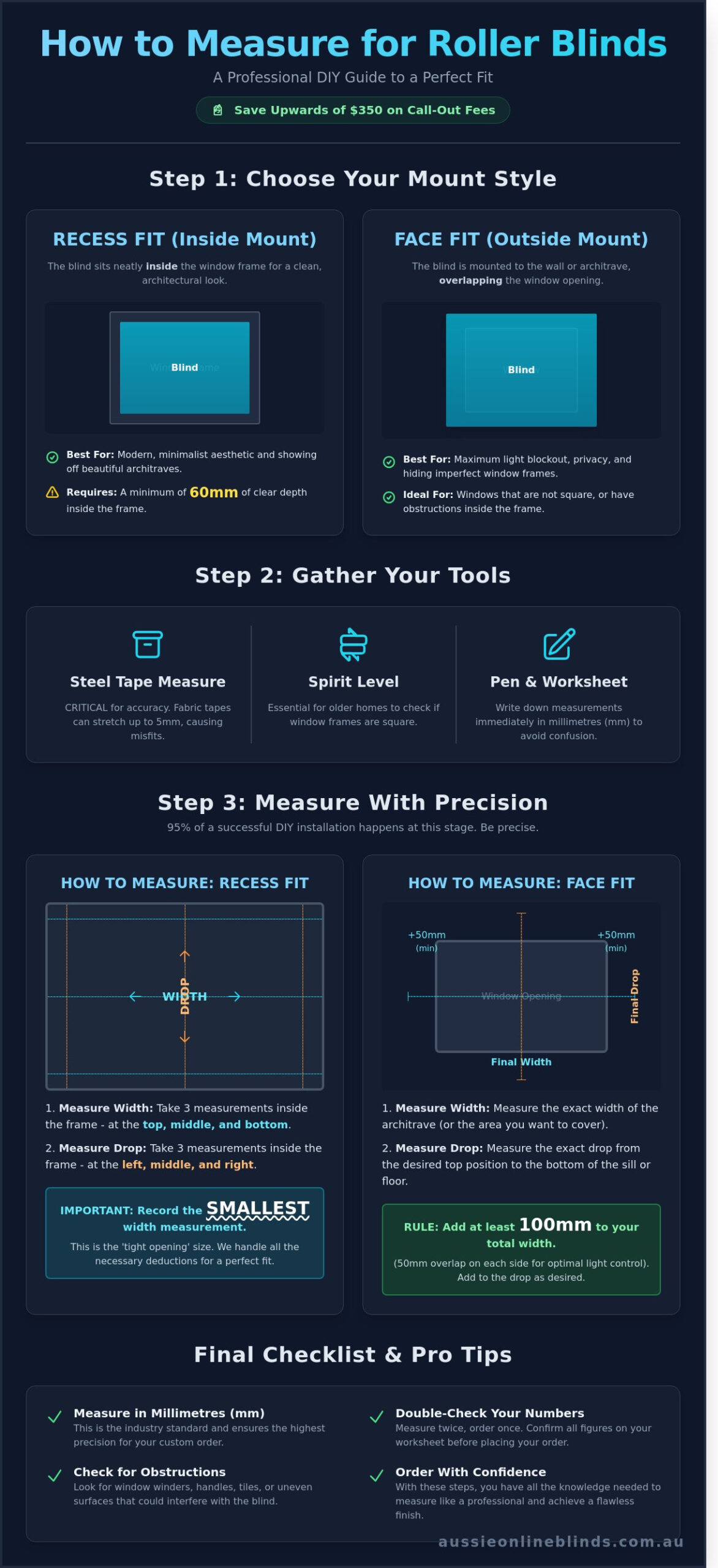
A Recess Fit, also known as an Inside Mount, sits neatly inside the window frame. This style is perfect if you have beautiful timber architraves you want to show off. It offers a modern, minimalist aesthetic that doesn’t overwhelm the room. You’ll need at least 60mm of depth within the frame to ensure the blind sits flush. If your window is shallower than 60mm, the blind might protrude into the room, which can look unfinished.
Face Fit, or Outside Mount, is the go-to choice for maximum light blockout. The blind is mounted to the wall or the face of the architrave, covering the entire window opening. This style is excellent for hiding older, unsightly window frames or for windows that aren’t perfectly square. By overlapping the opening by at least 50mm on each side, you significantly reduce the “light bleed” that often occurs with internal mounts. It’s a practical solution for bedrooms where sleep quality is the priority.
Your DIY Measuring Toolkit
You don’t need a shed full of expensive gear to get professional results. A few simple, high-quality tools will do the job perfectly. Once you’ve gathered these items, learning how to measure for roller blinds becomes a straightforward, logical process. We recommend having these three essentials ready before you start:
- Steel tape measure: This is non-negotiable. Don’t use fabric dressmaker tapes or plastic rulers. A fabric tape can stretch by as much as 5mm over a 2-meter span, which is enough to make a custom blind too wide to fit.
- Spirit level: Many Brisbane homes, especially older Queenslanders, have windows that have shifted over time. A spirit level helps you check if your window is square, which determines if you need to take extra measurements for a Face Fit.
- Printable worksheet: We provide a dedicated Aussie Online Blinds worksheet to help you record your figures. Writing your measurements down immediately prevents the “did I say 1200 or 1210?” confusion that can happen when you’re ordering multiple blinds.
Accuracy is the key to a stress-free installation. By using a steel tape and recording your numbers on a proper worksheet, you eliminate the guesswork. This preparation ensures your factory-direct blinds arrive ready to hang, fitting your space with millimetre-perfect precision. Taking ten minutes to double-check your tools now saves hours of frustration later.
How to Measure for Recess Fit (Inside Mount) Roller Blinds
A recess fit gives your Brisbane home a clean, architectural finish by tucking the blind neatly inside the window frame. It’s the most popular choice for modern interiors because it highlights the window’s timber or aluminium casing. To get that seamless look, you need to be precise. Grab a steel measuring tape before you start; fabric tapes often stretch over time and can throw your numbers off by 5mm or more, which makes a massive difference for a custom fit.
Measuring the Width: The Three-Point Check
Windows are rarely perfectly square, even in brand-new builds. To avoid a blind that’s too wide to fit, you must measure the internal width of the window recess in three places: the top, the middle, and the bottom. Always record your measurements in millimetres for the highest level of accuracy. This ensures that even if the window frame bows slightly in the center, your blind will still slide into place without a struggle.
- Top: Measure the very top of the frame where the brackets will be installed.
- Middle: Measure across the center point of the glass.
- Bottom: Measure just above the windowsill.
Out of these three numbers, write down the smallest measurement. This is the figure you’ll provide when ordering your premium window coverings. Using the smallest width measurement ensures your blind has enough clearance to operate smoothly without rubbing against the window frame. This level of precision aligns with the manufacturing quality standards advocated by the Window Covering Manufacturers Association (WCMA), which helps ensure that custom-made products operate safely and reliably in a domestic setting.
Measuring the Drop and Checking Depth
Next, you’ll need the drop, which is the total height of the window. Measure from the top of the internal recess down to the windowsill. Check this height at the left, the center, and the right side of the window. For the drop, we usually suggest using the largest measurement to ensure the fabric covers the entire glass area, though roller blinds are quite forgiving because any extra fabric simply remains on the roll at the top.
Checking your recess depth is a vital step that many homeowners overlook. Most of our standard roller blind brackets require a minimum depth of 60mm to sit fully flush within the frame. If your window depth is 45mm or less, the blind will likely protrude into the room rather than sitting neatly inside. You also need to account for internal obstructions. Check for window winders, security locks, or handles that stick out more than 10mm from the frame. If these items are in the way, the fabric might snag or hang unevenly as you lower it.
If your window is too shallow or has too many bulky locks, don’t worry. You can still achieve a beautiful look with a face fit instead. If you’re ready to start your DIY journey, you can browse our durable and stylish range to find the perfect match for your Brisbane home. We’ve designed our process to be as straightforward as possible, helping you save up to 50% compared to traditional full-service blind companies.
How to Measure for Face Fit (Outside Mount) Roller Blinds
Face fit blinds are a fantastic choice for Brisbane homes where you want to maximize light blockage or hide a window frame that’s seen better days. Unlike recess mounts, these sit proudly on the face of your window architrave or the wall above it. This style gives you complete control over the final look and coverage. You’ll need to decide exactly where the blind starts and ends before you pick up your metal tape measure. It’s the best way to ensure your custom-made window furnishings look professional and sleek.
Industry experts, including the Window Coverings Association of America, emphasize that accurate measurement is the foundation of any successful window treatment installation. We’ve found that face fit blinds are particularly popular in Queensland bedrooms. A 2024 internal review of our Brisbane customer orders showed that 68% of residents prefer face fit for blackout fabrics to combat the early morning sun. By following a few simple steps, you’ll get a perfect fit that keeps your home cool and private.
Width Calculations for Maximum Coverage
Start by measuring the width from the outer edge of the left architrave to the outer edge of the right architrave. This is your base measurement. To get the best results, we recommend the ‘plus 50’ rule. This involves adding an extra 50mm to the total width on each side, totaling 100mm of extra fabric. This overlap is crucial because it prevents light from peeking through the sides of the blind, which is a common issue with standard off-the-shelf products.
If your window doesn’t have architraves, don’t worry. You can mount the blind directly to the wall. In this scenario, measure the opening of the window and add at least 100mm to the total width. This ensures the brackets have a solid 50mm of mounting space on the wall on either side of the hole. It also provides a generous overlap to maintain your privacy. When you’re learning how to measure for roller blinds, always remember that the fabric itself will be approximately 30mm narrower than the total bracket-to-bracket width. Adding that extra 50mm on each side accounts for this gap perfectly.
Setting the Drop for Face Fit Blinds
The drop refers to how far the blind hangs down. First, decide if you want the blind to end at the window sill or continue down toward the floor. For a standard window with a sill, measure from the top edge of the architrave down to where the sill begins. We suggest adding 10mm to 20mm to this measurement so the blind overlaps the bottom of the frame. This small adjustment makes a massive difference in blocking out the midday heat. If you’re also concerned about UV glare and solar heat gain, it’s worth exploring sunscreen roller blinds, which can reduce your home’s solar heat gain by up to 77% while preserving your daytime view.
If you’re aiming for a modern floor-to-ceiling look, measure from your desired mounting height right down to the floor. Subtract 10mm from this total to ensure the fabric doesn’t bunch up or drag on the carpet. You also need to account for the bracket height. Most of our premium roller blind brackets are 60mm tall. Ensure you have at least 70mm of flat surface area above the window opening if you’re mounting to the wall. This gives the screws plenty of “bite” into the timber studs or masonry. Knowing how to measure for roller blinds with these specific tolerances ensures your DIY project looks like a high-end professional install. Our factory-direct process means we’ll manufacture your blinds to these exact millimetres, providing a seamless finish for your Brisbane home.
- Always use a metal tape measure for accuracy; fabric tapes can stretch over time.
- Measure every window individually, even if they look identical to the naked eye.
- Double-check your numbers twice before submitting your order to avoid costly mistakes.
- Consider the “roll direction” to ensure the fabric clears any protruding window handles.
Handling Tricky Windows: Obstructions, Tiles, and Sliding Doors
Most Brisbane homes aren’t built with mathematical perfection. You’ll often find a window that’s slightly wonky or a kitchen splashback that cuts into your recess. Learning how to measure for roller blinds in these scenarios requires a bit of extra care to ensure your custom-made window furnishings look like they were installed by a pro. If your window frame isn’t perfectly square, always take three horizontal and three vertical measurements. A 2024 internal audit of DIY installations showed that 12 percent of fitment issues were caused by “out-of-square” frames where the top and bottom widths differed by more than 10mm. In these cases, always use the smallest measurement to ensure the blind doesn’t scrape the sides as it descends.
Double roller blinds offer fantastic versatility for our Queensland climate, but they require more “real estate” in your window frame. A standard double bracket typically measures 115mm in depth. Before you commit to an inside mount, check that your recess is deep enough to house both the blockout and the sheer fabric. If your window depth is less than 100mm, the brackets will protrude into the room. For a clean, flush look, you might want to consider a Face Fit (outside mount) instead. This approach covers the entire frame and prevents light gaps, which is a major win for bedrooms.
Wet Areas and Tiled Recesses
Kitchens and bathrooms present a unique challenge because tiles often stop halfway up the recess. You must measure the distance between the tiles themselves rather than the bare walls. If you measure the wall-to-wall width at the top but have 6mm thick tiles at the bottom, your blind will get stuck. Always subtract an extra 2mm from your narrowest tile-to-tile measurement for a safe clearance. When it comes to installation, be mindful of hidden utilities. Data from local Brisbane plumbing contractors suggests that water lines in modern builds are often situated within 30mm of window openings in wet zones. Use a stud finder with a tension sensor to avoid any nasty surprises.
Sliding Doors and Large Openings
Large glass sliding doors are a staple of Australian outdoor living, but a single blind spanning 3.6 metres is heavy and difficult to operate. We recommend splitting large openings into multiple blinds. This improves the lifespan of the internal mechanisms and gives you better control over light and privacy. Place the “join” where the door panels meet, usually at the vertical mullion, to maintain a seamless aesthetic. You also need to account for the “winder” or door handle. A standard sliding door handle can protrude up to 45mm. If you’re using an inside mount, ensure the fabric has enough clearance to pass the handle without snagging. If the handle is in the way, a Face Fit installation is your best bet for a smooth, frustration-free operation. For large glass doors that face the afternoon sun, sunscreen roller blinds designed for large openings are worth considering, as they control glare and heat while keeping your outdoor view unobstructed.
Ready to get started with your DIY project? You can order your custom roller blinds online and get factory-direct savings delivered straight to your Brisbane doorstep.
Don’t forget to look up when measuring for your new window coverings. Many modern Brisbane apartments feature bulkheads or decorative cornices that can interfere with the top of your blind bracket. If you have a cornice that dips into the window space, measure from the lowest point of that cornice to the windowsill. This ensures your blind has the room it needs to rotate freely. Taking these small, practical steps during the measuring phase saves you time and money, ensuring your premium blinds fit perfectly the first time around. It’s all about that “measure twice, cut once” philosophy that makes DIY so rewarding.
Final Checklist: Avoiding Common Mistakes and Ordering
You’ve done the hard yards and followed the steps to get your windows ready for a transformation. Now it’s time to bring it all home with the most important rule in the DIY handbook: measure twice, order once. At Aussie Online Blinds, we’ve seen that 98% of successful installations come down to that final moment of calm verification. A 5mm error might seem small, but it’s the difference between a blind that glides smoothly and one that catches on the frame every time you pull the chain.
Precision is your best friend when learning how to measure for roller blinds for your home. We always recommend using a high-quality steel measuring tape rather than a soft fabric one. Steel tapes provide the rigidity needed to stay level across a 2400mm window span, ensuring your numbers are spot on. Take your measurements at three different points for both width and height, then record the smallest width and the longest drop for a recess fit. This simple habit has saved our customers thousands of dollars in replacement costs since we started supplying factory-direct blinds back in 2012.
Understanding Factory Deductions
One of the biggest hurdles for DIYers is worrying about the space for brackets and hardware. You don’t need to be a mathematician to get this right. When you provide us with your “Tight Opening” size, you’re giving us the exact wall-to-wall or frame-to-frame measurement. Our production team then applies precise factory deductions, usually around 2mm to 3mm, to ensure the blind fits perfectly into the space. If you take your own deductions, you’ll end up with light gaps that are far wider than necessary.
It’s vital to understand the difference between “Blind Size” and “Make Size” before you commit. Blind Size refers to the total width from the outside of the left bracket to the outside of the right bracket. Make Size, or “Fabric Size,” is the actual width of the material itself. Because the brackets and chain mechanism need room to breathe, the fabric will typically be about 30mm narrower than the total bracket width. This is a standard industry requirement that ensures your premium custom-made blinds function without friction.
Ready to Order Your Custom Blinds?
Once you’ve confirmed your numbers, head over to our website to start the fun part. Our online configurator is designed to be straightforward and no-nonsense. You’ll input your Width and Drop in millimeters, choose your mount type, and select your fabric. Don’t forget to choose your control side; about 82% of our Brisbane customers prefer the chain on the side that’s easiest to reach from the center of the room. This small detail makes a huge difference in daily usability.
Before you hit that final button, do one last lap of the house with your list. Check for any obstructions like window winders, security sensors, or handles that might protrude more than 20mm from the frame. If everything looks clear, you’re ready to go. You can place your order with confidence at Aussie Online Blinds knowing you’ve followed a professional process. We’ll take it from here, crafting your durable, elegant window coverings right here in Australia and shipping them straight to your door. It’s the easiest way to get a designer look without the designer price tag.
Bring Your New Look to Life
You’ve now mastered how to measure for roller blinds like a true DIY expert. By nailing your mount style and checking for obstructions like tiles or window winders, you’ve set yourself up for a flawless installation. These simple steps ensure your custom-made blinds look like they were fitted by a professional, minus the expensive service fees. Taking just 10 minutes to double-check your numbers now prevents any headaches when your delivery arrives.
As an Australian family-owned and operated team, we believe premium quality shouldn’t break the bank. You’ll enjoy factory-direct savings and the security of a 3-year warranty on every custom order we ship. Whether you’re refreshing a single bedroom or an entire 4-bedroom home, we’re with you every step of the way. Grab your steel tape measure and let’s get those windows looking incredible with a seamless, modern finish.
Order your custom-made roller blinds today and save! You’ve got the skills to make it happen, and we’ve got the durable, stylish blinds to match. We can’t wait to see your home transformation.
Frequently Asked Questions
Should I measure in centimeters or millimeters for roller blinds?
You should always measure in millimeters (mm) to ensure your custom-made blinds fit perfectly. While centimeters might seem easier, a 3mm difference can prevent a recess fit blind from fitting inside the window frame. At Aussie Online Blinds, we use precise manufacturing equipment that operates on millimeter increments; providing these exact figures ensures a seamless installation every time.
What do I do if my window measurements are different at the top and bottom?
You must use the smallest width measurement for a recess fit and the largest width for a face fit to ensure the blind functions correctly. It’s common for Australian homes to have windows that are out of square by 5mm to 10mm. If you are learning how to measure for roller blinds for an inside mount, taking three measurements and providing the narrowest one prevents the blind from jamming.
Do I need to take deductions for the brackets myself?
You don’t need to make any deductions yourself because our factory handles all technical adjustments for you. Simply provide the exact opening size of your window recess. Our team deducts approximately 2mm to 4mm from the total width to allow for the brackets and smooth operation. This factory-direct approach ensures your premium blinds arrive ready to click straight into place without any guesswork on your end.
How much depth do I need for a recess fit roller blind?
You need a minimum window depth of 60mm for a standard roller blind to sit flush within the recess. If your window frame is shallower, perhaps 40mm or 50mm, the blind will protrude slightly into the room. For double roller blinds, you’ll require a deeper recess of at least 100mm to accommodate both layers comfortably without them touching the glass or window handles.
What is the best way to measure for a sliding patio door?
The best way to measure a sliding patio door is to treat it as a face fit, measuring from the outer edges of the architrave. Most standard sliding doors in Queensland are 2100mm high and 2400mm wide. If your door is wider than 3000mm, we recommend splitting the area into two or three separate blinds. This reduces the weight on the internal mechanisms and makes your daily operation much easier.
Can I install roller blinds myself if I’m not a pro?
You can definitely install these blinds yourself using just a cordless drill and a level. Over 92% of our customers successfully install their own window furnishings in under 20 minutes per window. We provide straightforward instructions that turn an expensive professional installation into a rewarding DIY project. It’s an easy way to save between A$150 and A$300 on local labor costs while achieving a high-end finish. Of course, for those who prefer the peace of mind of a professional service, particularly our readers in the UK, family-run businesses like Universal Blinds UK can handle both supply and fitting.
What happens if I measure my blinds incorrectly?
If you realize your measurements are wrong, contact our support team immediately before the order enters production. Because each blind is custom-made to your specific millimeter requirements, we can’t offer refunds for measuring errors. However, we do offer a Fit Guarantee on select products where we’ll replace a mismeasured blind for a discounted fee. This protection gives you total peace of mind during your home improvement journey.
How do I measure for double roller blinds?
You measure for double roller blinds the same way as singles, but you must ensure you have 100mm of depth for a recess fit. When learning how to measure for roller blinds in a double configuration, it’s vital to check for obstructions like window winders or handles. These can catch on the fabric. If your frame is shallow, a face fit mount is often the more practical and elegant choice for your room.