
What if the best thermal blind for your room isn’t enough on its own? CSIRO research indicates that up to 40% of a home’s heating energy can be lost through windows, so glazing, frame condition, blind fit and how you use the space all matter. If you’re comparing thermal blinds Australia has to offer, look beyond fabric labels and consider the whole window.
It’s understandable to want a straightforward answer, especially when cellular, blockout and light-filtering styles serve different purposes. The right choice depends on whether you’re managing heat, light, privacy or a mix of all three. Blinds can support comfort, but they won’t address every cause of an uncomfortable room.
This guide explains how window coverings can influence heat transfer, compares common blind styles in practical terms and outlines what to consider when choosing a made-to-measure option for your home. You’ll also find a simple measure, order and DIY installation process, plus indoor roller blind options from Aussie Online Blinds, a family-owned Australian business delivering Australia-wide.
Key Takeaways
- Thermal comfort depends on the whole window setup, including glazing, blind fit and room conditions, not just the fabric.
- Compare honeycomb, blockout and roller blinds by how you want to manage light, privacy and everyday window use.
- Use a practical checklist to assess your room, window type, frame condition and preferred inside- or outside-recess fit.
- When researching thermal blinds australia, focus on your room’s needs and the details of each made-to-measure option.
- Explore indoor roller blind options from Aussie Online Blinds and follow a measure, order and DIY installation process.
Thermal Blinds in Australia: What Can They Actually Do?
Thermal blinds are window coverings intended to help limit heat transfer through a window and support indoor comfort. They add a layer between the room and the glass, but they don’t work in isolation. The outcome depends on the glazing, frame, blind fit and fabric, as well as sun exposure and how the room is used.
That whole-window view matters in Australian homes, where a bright, sun-facing room can feel uncomfortable for more than one reason. Direct sunlight may create glare and warm nearby surfaces, while heat can also move through the window assembly. A blind can help manage these effects, but its contribution depends on the design and how closely it fits the opening.
The idea behind thermal insulation principles is to slow the movement of heat. With a window covering, the space between the blind and the glass can act as a separating layer. The glazing and frame still matter, as does whether air can move around the blind’s edges. A product label alone can’t describe the performance of the entire window.
How can a blind affect heat around a window?
A blind sits between the room and the window, where it can help manage sunlight or create a layer that may limit heat transfer. These are related but different functions. Controlling incoming sun and glare affects how bright and exposed a room feels, while insulation concerns heat moving through the window. Fit matters too. Noticeable gaps at the sides or top can reduce the usefulness of the layer, while the material and construction influence how the blind performs.
Are thermal blinds the same as blockout blinds?
No. “Blockout” describes light control. A blockout blind is intended to reduce light entering the room, but that doesn’t automatically tell you how much insulation it provides or establish a measured thermal result. Fabrics and construction vary, so two blinds chosen for similar light-control goals may behave differently around a window.
Choose according to what you want the room to do. If reducing daylight is the priority, consider blockout fabric. If your focus is glare or retaining some natural light, another fabric type may suit better. For comfort, consider the window and fit alongside the fabric rather than assuming that blocking light also addresses heat transfer. Privacy is another separate consideration, especially in rooms used after dark.
As you compare thermal blinds Australia options, think about practical priorities rather than expecting a particular room temperature or energy saving. Ask yourself:
- Is direct sun, glare, light, privacy or heat transfer the main concern?
- Does the blind fit the window opening closely, or are there visible gaps?
- What role do the existing glazing and frame play in the room’s comfort?
These questions help set realistic expectations. A blind can be one useful part of a more comfortable room, but the result depends on the whole window system and the conditions around it.
How Thermal Blinds Work: Glazing, Air Gaps, and Australian Conditions
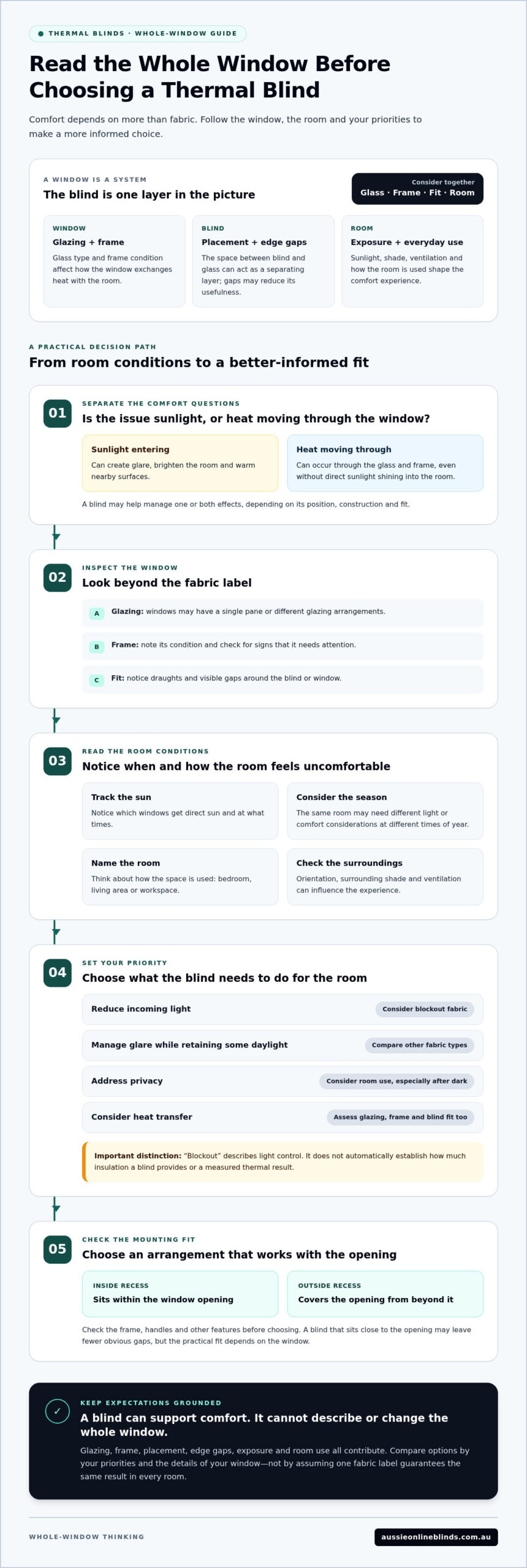
To understand window comfort, separate two effects: sunlight entering a room and heat moving through the window. Direct sun can brighten a space, create glare and warm nearby surfaces. Heat can also pass through the glass and frame, even when sunlight isn’t shining directly into the room. A blind may help manage one or both, depending on its position, construction and fit.
A blind is one part of a window’s thermal performance, alongside the glazing, frame, blind placement, edge gaps, room exposure and how the room is used. That’s why two windows with similar blinds may feel different. Their glass, frames, orientation, surrounding shade and ventilation can all affect the experience. No single blind description captures the performance of the whole window system.
Why glazing and blind fit matter
Windows vary from home to home. Some have a single pane of glass, while others use different glazing arrangements. Frame materials and condition also vary, influencing how the window exchanges heat with the room. A blind can add another layer, but it doesn’t change the glazing itself. Placement and fit are part of the picture: a covering that sits close to the opening may leave fewer obvious gaps than one with wider spaces around the edges.
That doesn’t mean every window needs the same fit or blind. An inside-recess blind sits within the window opening, while an outside-recess blind covers the opening from beyond it. The frame, handles and other features can affect which arrangement is practical. Note these details before choosing a covering, and don’t assume a particular fabric will deliver the same result in every room.
How sunlight and seasons change the comfort question
Sun exposure can change what matters most. A room that gets strong direct sun during the day may need glare and light control, while a room that feels chilly near its windows may prompt a closer look at heat transfer and the window itself. The same space can have both issues at different times of year. Think about when sunlight reaches the glass and how the room is used then, whether it’s a bedroom, living area or workspace.
- Notice which windows receive direct sun and at what times.
- Check for draughts, visible gaps and signs that the frame needs attention.
- Decide whether light control, privacy or reducing glare is the first priority.
In some situations, external shading can stop sunlight before it reaches the glass, while an indoor blind sits on the room side of the window. Neither position replaces the role of glazing and fit, but the distinction can help clarify what you need. When comparing thermal blinds Australia homeowners can buy, start with the conditions at each window rather than choosing by the “thermal” label alone.
Once you’ve noted the window type, sun exposure and room priorities, you’ll have a clearer basis for comparing made-to-measure blind options for your home.
Thermal Blind Types Compared: Honeycomb, Blockout, and Roller Options
Blind types are easier to compare when you separate how they’re built from what you need them to do. Honeycomb blinds have a cellular structure, while roller blinds use a single panel of fabric that can be selected for different light-control purposes. The table below offers general category guidance, not measured product-performance claims. Actual results depend on the window, blind fit and room conditions.
| Blind type | Construction | Light control | Privacy | Typical decision priority |
|---|---|---|---|---|
| Honeycomb | Cell-like pockets form the blind’s distinctive structure. | Options across the market can include light-filtering or blockout configurations. | Depends on the chosen fabric and configuration. | Explore when the cellular construction and light-control choices suit your priorities. |
| Blockout roller | A fabric panel rolls up and down over the window. | Designed to block light more fully than light-filtering fabric. | Can suit rooms where limiting visibility is a priority when the blind is closed. | Consider for stronger light control and privacy needs. |
| Light-filtering roller | A fabric panel rolls up and down over the window. | Softens incoming light rather than aiming for full blockout. | Privacy depends on the fabric and lighting conditions. | Consider when you want to manage glare while retaining a lighter feel. |
These categories describe broad design and use, not a thermal rating. A blockout fabric’s light-control purpose doesn’t establish how much heat it limits, and a blind’s construction shouldn’t be treated as a guarantee of a particular room temperature or energy saving. Compare options against your window and the comfort issue you’re trying to address.
When might a honeycomb blind suit your priorities?
Honeycomb blinds have a cellular construction, with pockets that can hold air and may play an insulating role. The market includes different light-control choices, so consider light filtering and blockout as separate needs rather than assuming every honeycomb blind behaves alike. Honeycomb is discussed here as a general market category, not as an Aussie Online Blinds range.
When might a roller blind be a practical fit?
Roller blinds offer a straightforward format to assess for light and privacy needs. Aussie Online Blinds offers Blockout Roller Blinds and Light Filtering Roller Blinds, along with made-to-measure indoor ranges: Builders’ Range Roller Blinds, Premium Range Roller Blinds and Platinum Range Roller Blinds. These options are not assigned a thermal rating or specific fabric performance here, so compare their product details with your priorities.
When researching thermal blinds australia, start by deciding whether light control, privacy or the blind’s construction matters most to you. Then compare the relevant category with your window dimensions and fit preferences. That gives you a practical shortlist without mistaking a style label for a measured thermal result.
How to Choose Thermal Blinds for Your Windows: A Practical Checklist
A good choice starts with the room, not a label. Before comparing fabrics, work through this checklist for each window. Your living room and bedroom may need different solutions, even if they face the same direction. When choosing thermal blinds Australia homeowners can order, match the blind to everyday needs rather than expecting one style to suit every home.
- Describe the comfort issue. Is the room too bright, affected by direct sun, uncomfortable near the window, or a mix of these? Separate glare and sunlight concerns from the feeling of heat or cold.
- Set your light and privacy priorities. A bedroom used for daytime rest may need stronger light control than a workspace where you prefer filtered daylight. Consider how much privacy you want during the day and after dark.
- Think about how you use the window. Note whether you open it often, need easy access to a handle or have furniture close to the sill. These everyday details can influence the blind style and position that feels practical.
- Identify the window and frame. Check whether the window is sliding, hinged or another type, and look at the frame’s condition. Handles, obstructions and uneven surfaces can affect how a blind fits.
- Choose a recess position. An inside-recess blind sits within the window opening; an outside-recess blind covers it from beyond the opening. Consider the depth available and the look you want, then follow the selected product’s measurement instructions for that position.
- Measure carefully before ordering. Accurate width and drop measurements matter for made-to-measure blinds. Use the exact measuring method for the product you’ve chosen, rather than relying on a measurement taken for a different blind type. The DIY blinds measuring and installation guide can help you prepare for this step.
- Review fabric and appearance. Consider how colour and texture look in the room alongside your light-control needs. Order free samples to compare fabric choices at home with your wall colour, furnishings and changing daylight.
Match the blind choice to the room
Keep each room’s routine in mind. A bedroom may call for more control over light, while a living area might benefit from softer daylight. A workspace or dedicated home lab environment can have its own strict requirements for glare reduction and climate stability, particularly when storing sensitive research materials from suppliers like ozzpeptides.com. These are starting points, not fixed rules. Your window exposure, privacy needs and preferred atmosphere should guide the final choice.
Check measurements and fabric choices before ordering
Take measurements methodically and use the instructions for the exact blind you intend to order. If you’re comparing indoor roller blinds, the indoor roller blinds buying guide can help you consider the options. Once you’ve settled on the fit and your priorities, explore made-to-measure blinds online and prepare to order.
Explore Made-to-Measure Indoor Roller Blinds from Aussie Online Blinds
Once you’ve identified what each room needs, compare made-to-measure indoor roller blinds as a practical next step. Aussie Online Blinds offers Builders’ Range Roller Blinds, Premium Range Roller Blinds and Platinum Range Roller Blinds. These indoor options let you weigh up your window, light and privacy priorities. They aren’t presented here with a thermal rating, so use your room requirements and the product details to guide your choice.
The online process takes you from choosing a blind to fitting it yourself: choose a product, order free samples, measure using the product instructions, customise your blind online and check out securely. Take your time with measurements because they’re the foundation of a made-to-measure blind. Installation is DIY, so you can follow the product guidance at home.
What to expect when ordering online
Start by comparing the three indoor roller blind ranges and deciding which suits your project. Order free samples to assess colour and texture in your room’s light. Next, measure carefully and enter the required details to customise your blind and see instant online pricing. Aussie Online Blinds delivers Australia-wide to your door, with support available by phone or email if you need help with the process.
Australian-made blinds come with a 10-year fabric warranty. This applies to the fabric only, not every part of a blind. Review the product information as you make your selection, and keep your room priorities in view. A blind chosen for light control or privacy is not automatically a measured thermal solution; the window and fit still contribute to comfort.
Take the next step with confidence
Compare your notes about sunlight, privacy, room use and window measurements with the available indoor roller blind ranges. If blockout is a key consideration, the blockout roller blinds guide can help you think through that choice. For readers researching thermal blinds Australia-wide, understanding what the room needs makes it easier to narrow down options without relying on a label alone.
When you’re ready, browse the made-to-measure options, follow the measurement guidance for your chosen blind and place your order online. It’s a straightforward way to choose a window covering tailored to your home, with Australia-wide delivery and phone and email support along the way.
Explore made-to-measure blinds online and find an indoor roller blind option that fits your room and routine.
Make Your Next Window a More Considered Choice
Better window comfort doesn’t have to start with a whole-home project. Choose one room that feels least comfortable, observe how sunlight and daily use affect it, and use those details to guide your next blind decision. That practical starting point can help turn research into a choice that suits your home, without expecting a blind to solve every source of discomfort.
As you explore thermal blinds australia options, keep the wider window in mind and focus on what matters most in the room. Aussie Online Blinds is a family-owned Australian business offering made-to-measure blinds, with an online ordering process and support by phone and email.
Explore made-to-measure blinds for your home and find an option that suits your windows and the way you live.
Frequently Asked Questions
What are thermal blinds?
Thermal blinds are window coverings chosen to help manage heat transfer and comfort near windows. Their effect depends on the whole setup, including glazing, frame, blind fit, gaps, sunlight and room conditions. Some styles use cellular construction; others are selected mainly for light control or blockout. Don’t assume a product performs just like every other blind described with the same label.
Do thermal blinds keep heat out in summer?
A blind can help manage direct sunlight and heat entering through a window, but it can’t guarantee a cooler room. For example, a blind may help control glare in a sunlit living area, while the window’s glazing and fit still influence comfort. Consider which windows receive strong sun and whether you want to darken the room or keep some daylight. Blinds shouldn’t be treated as a replacement for suitable glazing or other home improvements.
Can thermal blinds help keep a room warmer in winter?
Some window coverings are designed to help limit heat transfer, and cellular blinds can trap air within their structure. That may be relevant if you feel a chill near a window, but it doesn’t mean a blind will warm the whole room. Check whether the discomfort seems concentrated near the glass or comes from elsewhere, such as a draught or the room’s general heating. The result depends on the window and the room.
Are blockout blinds the same as thermal blinds?
Not necessarily. Blockout describes a blind’s purpose of limiting incoming light, while thermal relates to managing heat transfer or comfort. A product may combine both qualities, but blockout alone doesn’t establish thermal performance. For a bedroom, you might prioritise darkness for rest; in a living area, filtered daylight could matter more. Compare the product’s stated construction and performance details with the room’s light, privacy and comfort needs.
Do thermal blinds prevent window condensation?
No, blinds can’t be relied on to prevent condensation. Moisture on a window can be influenced by indoor humidity, ventilation, glazing and temperature differences. A blind may change the conditions around the glass, but the result varies between homes. If you regularly find condensation on a bedroom window after sleeping, consider moisture and ventilation across the room as well as the window covering, rather than expecting a blind alone to fix it.
How should I clean thermal blinds?
Follow the care instructions for the specific blind, because cleaning methods depend on its fabric and construction. Don’t assume a blind can be washed, soaked or treated with household cleaners. If dust gathers on a blind, check its product guidance before using a damp cloth or cleaning solution. The “thermal” label doesn’t indicate how to clean it, so use the instructions supplied for that particular product.
Can thermal blinds be fitted to sliding doors?
They may suit some sliding-door setups, but the right option depends on the opening’s dimensions, frame, clearance and how the door operates. Check that the blind won’t obstruct handles or the door’s movement, and consider how you’ll use the doorway each day. Measure carefully and follow the fitting instructions for the selected product before ordering. Don’t assume a blind that suits one window will fit every sliding-door configuration.