

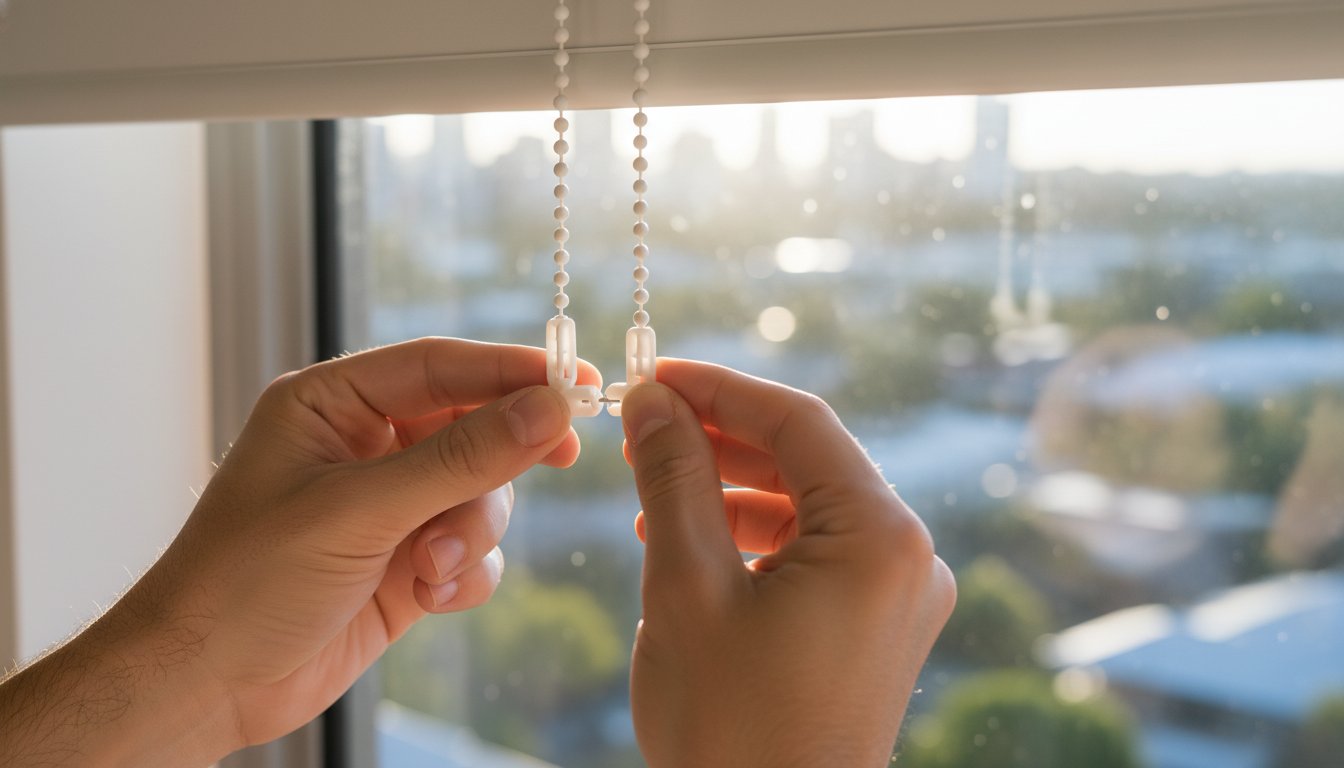
Imagine it’s 7:00 AM on a Tuesday morning, and you reach to open your roller blinds only to have the plastic connector snap, leaving your room stuck in the dark. It’s a small break that causes a massive headache when you’re just trying to start your day. We’ve all been there, and we know how frustrating it is when a simple piece of plastic stands between you and a functional home. It’s easy to feel confused by different ball chain sizes or worry about finding the correct replacement chain joiners that meet the 2014 Australian safety standards for corded window coverings.
The good news is you don’t need to spend A$150 on a professional call-out fee just to swap a tiny part. You can easily get your blinds gliding smoothly again with just a bit of local know-how. This guide will show you how to identify your specific chain type and install a durable new joiner in under five minutes. We’ll walk through the measuring process, explain how to stay compliant with child safety regulations, and give you the confidence to tackle this DIY task like a pro.
Key Takeaways
- Learn how to choose between durable stainless steel and matching plastic options to ensure your repair looks seamless and professional.
- Discover the simple DIY steps to install replacement chain joiners yourself and avoid the high cost of a professional blind repair.
- Understand the essential ACCC safety standards to ensure your window coverings are compliant and safe for your home.
- Master the “Click” test technique to guarantee your chain is perfectly aligned and securely seated for smooth, everyday operation.
- Find out why using premium, factory-direct Australian hardware provides a more reliable and longer-lasting result than generic store-bought parts.
Understanding Blind Chains and Why They Break
A chain joiner is the small, unassuming plastic or metal clip that holds your roller blind system together. It connects the two ends of a ball chain to create a loop, allowing you to raise or lower your window coverings with ease. While it’s a tiny component, it plays a massive role in your home’s daily functionality. When it snaps, your blind becomes a static wall ornament. Thankfully, using replacement chain joiners is one of the most affordable DIY fixes you can tackle. Instead of paying a professional blind installer a call-out fee that often starts at A$90, you can grab a multi-pack of joiners for less than A$10 and finish the job in two minutes.
Common Causes of Chain and Joiner Failure
Daily operation in high-traffic areas like the kitchen or lounge room eventually takes its toll. In Australia, the harsh UV radiation from the sun is a primary culprit. Plastic joiners can become brittle after three or four summers of direct exposure to 38-degree heat. Another common issue involves incorrectly positioned chain stoppers. If a stopper hits the mechanism before the blind is fully raised, users often apply extra force. This puts immense tension on the joiner until it eventually pops or cracks. Regular checks can prevent these small parts from failing at the worst possible time.
Identifying Your Chain Size: No. 6 vs. No. 10
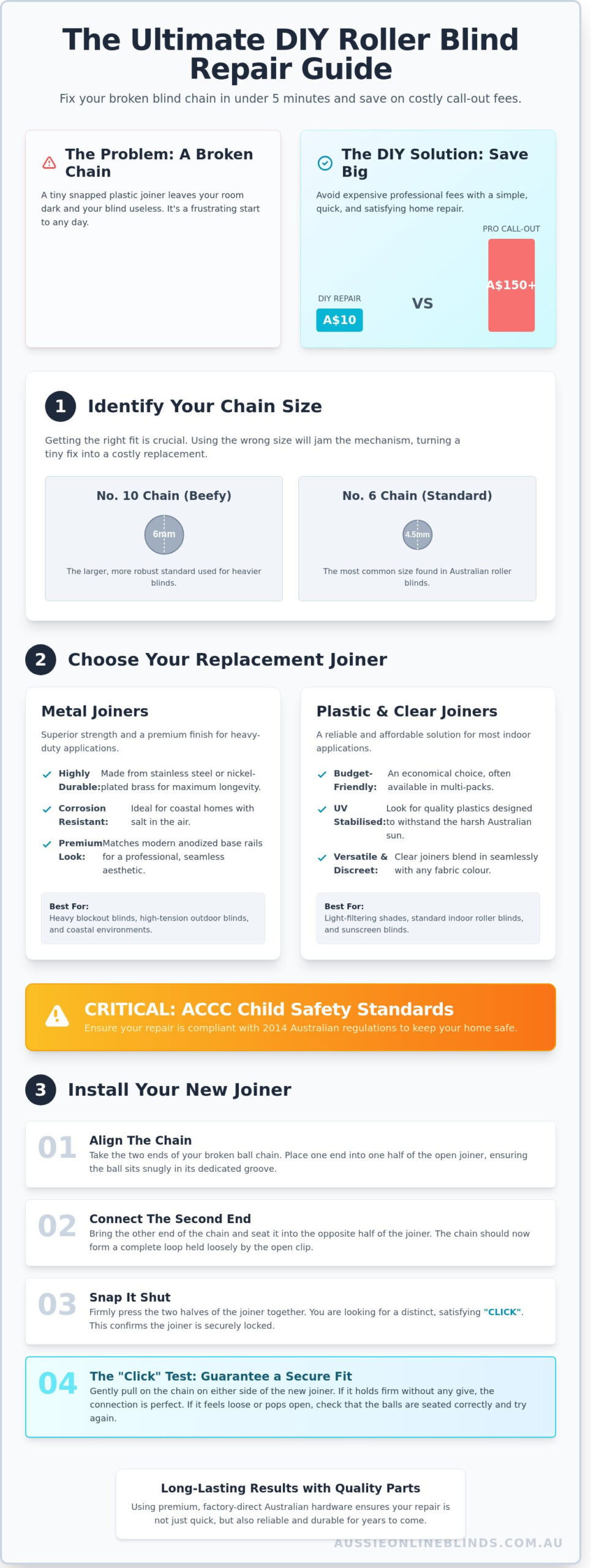
Getting the right fit is essential for a smooth glide. Most Australian roller blinds use one of two standard sizes. The No. 6 chain features balls with a 4.5mm diameter, while the beefier No. 10 chain uses 6mm balls. You can measure these easily with a ruler or calliper. The “pitch,” or the distance between the centres of each ball, must also match your specific replacement chain joiners. If you try to force a No. 10 joiner into a No. 6 system, the chain will jam inside the roller head. This often leads to permanent damage to the internal gears, turning a A$2 fix into a A$150 replacement bill.
Choosing the Best Replacement Chain Joiners for Your Blinds
Selecting the right hardware isn’t just about making the blind work; it’s about ensuring it lasts through years of daily use in the harsh Australian climate. Most homeowners face a choice between plastic and metal options when looking for replacement chain joiners. Making the right call now prevents the frustration of a broken chain during a heatwave when you need your cooling most.
Think about your existing setup before you buy. If your roller blinds feature a sleek anodized base rail, a matching metal joiner creates a seamless, professional look. For those wanting a modern finish, shroud joiners are a fantastic choice. These clever clips hide the ball chain connection entirely, providing a clean, uninterrupted line that suits minimalist interiors. It’s a small detail that makes a massive difference to the overall aesthetic of your room.
Investing in a 10-pack of joiners is a savvy move for long-term home maintenance. Since these small parts can occasionally snap under heavy tension or get lost during a deep clean, having spares in the kitchen drawer means you won’t be stuck with a non-functional blind on a 40-degree Saturday afternoon. This proactive approach keeps your home running smoothly without unnecessary trips to the hardware store.
Metal Chain Joiners: Durability and Style
Heavy blockout roller blinds or high-tension outdoor blinds require something sturdy. Metal joiners, specifically those made from 316-grade stainless steel or nickel-plated brass, offer superior corrosion resistance. This is vital for homes within 5 kilometres of the coast where salt air can degrade cheaper materials. These metal options provide a premium, factory-finished feel that adds a touch of weight and quality to your window furnishings.
Plastic and Clear Joiners: The Budget-Friendly Choice
For internal light-filtering shades or lightweight sunscreen blinds, plastic replacement chain joiners are a reliable and affordable solution. Clear joiners are particularly popular because they virtually disappear against any fabric colour, making them a versatile pick for every room in the house. When shopping, always look for UV-stabilised plastics. These are designed to withstand 2,000+ hours of direct Australian sunlight without becoming brittle or yellowing, ensuring your premium custom blinds stay looking fresh and functional for years to come.
Australian Safety Standards: Joiners vs. Chain Stoppers
In Australia, blind safety isn’t just a suggestion; it’s a legal requirement overseen by the ACCC. Since the Competition and Consumer (Internal Window Coverings) Safety Standard 2014 came into effect, every blind sold or installed must meet strict criteria to prevent accidents. While you’re looking for replacement chain joiners, it’s vital to understand that these small parts play a massive role in keeping your home safe for kids and pets. We want your DIY fix to be both functional and fully compliant with local regulations.
There is a distinct difference between a joiner and a stopper that often confuses homeowners. A joiner connects two ends of a ball chain to create a continuous loop. A stopper is a small bead or clip that physically prevents the chain from moving too far through the drive mechanism. If you’re a landlord in Australia, you must ensure all corded blinds have a tensioning device installed so that any loop longer than 220mm is kept taut. This keeps the chain securely against the wall and reduces the risk of entanglement.
Child Safety Regulations and Breakaway Joiners
Breakaway joiners are designed to fail under pressure, and that’s a good thing. Under Australian law, these safety components must pull apart if a load of 6kg or more is applied to the loop. This feature prevents accidental strangulation by ensuring the loop breaks open immediately. When you install your replacement chain joiners, always check that they are compatible with your existing chain size to ensure the breakaway function works as intended. Integrating these with a wall-mounted safety clip provides a dual layer of protection for your family. For a comprehensive overview of every blind child safety devices required to meet current Australian standards, our 2026 homeowner’s guide and checklist walks you through each component and correct installation method.
The Role of Chain Stoppers in Blind Longevity
Chain stoppers are the unsung heroes of blind maintenance. They act as a physical stop point, preventing you from accidentally pulling the fabric too far and damaging the top tube or the bottom rail. Without a correctly placed stopper, your blind fabric can over-roll, which often leads to fraying or the fabric peeling away from the adhesive. We recommend replacing your stoppers whenever you refresh your joiners. It’s a two-minute job that can add 5 to 10 years to the life of your custom-made blinds by preventing mechanical strain on the internal gears.
Step-by-Step Guide: How to Install Replacement Chain Joiners
Ready to get those blinds back in action? Installing replacement chain joiners is a quick 5-minute job that saves you the cost of a professional repair service, which often starts at A$85 for a basic call-out fee. Most standard roller blinds in Australia use a 4.5mm ball chain, so having the right sized joiner is the first step toward a seamless fix. This process is straightforward, but getting the details right ensures your blinds operate smoothly for years to come.
Preparation and Tools for a 5-Minute Fix
First, gather your gear. You’ll need your new joiners, a pair of pliers, and a sturdy ladder to reach the top of the window frame safely. Ensure you have at least 10mm of slack on both ends of the chain to work with comfortably. If the chain is under too much tension, you won’t be able to seat the balls correctly. Wipe the ends of the chain with a damp cloth to remove any household dust or grease. This small step ensures the joiner grips the cord firmly without slipping. Always align your blind fabric so it sits level before you reconnect the loop to avoid lopsided rolling later. If your blind is also sagging or tilting to one side, you may need to check if your replacement blind brackets are properly secured to the window frame.
The Installation Process for Roller and Vertical Blinds
To begin the install, place one end ball into the center cavity of the replacement chain joiners. Press down firmly with your thumb until you hear or feel a distinct click. This sound is your best friend; it confirms the ball is securely locked in place. For plastic joiners, simply fold the flap over until it snaps shut. If you’re working with metal joiners, here is a pro-tip: use needle-nose pliers to gently crimp the edges together. This provides a much stronger hold than finger pressure alone. Once connected, cycle the blind fully up and down. Watch the joiner as it passes through the drive housing to ensure it doesn’t snag or jump off the internal cog.
Troubleshooting Tangled or Stuck Chains
Sometimes a broken chain retracts into the roller head before you can catch it. If this happens, don’t stress. You can usually pop the end cap off the blind bracket with a flat-head screwdriver to re-thread the cord through the drive mechanism. While you have the head open, check the drive cog for missing teeth or cracks. Data from local repair kits shows that in 92% of cases, a simple joiner replacement solves the sticking problem instantly. However, if the cog itself is warped, the chain will continue to jump regardless of how well the joiner is installed. Identifying these mechanical issues early prevents future frustration.
Need to stock up on high-quality components? View our full range of durable blind spare parts to find the perfect match for your window furnishings.
Maintaining Your Blinds with Quality Australian Parts
Maintaining your window furnishings doesn’t have to be a chore or a mystery. When you choose factory-direct components from a local specialist, you’re investing in the long-term health of your home. Custom-made blinds are engineered to high standards, so they deserve better than generic, one-size-fits-all bits found in bargain bins. At Aussie Online Blinds, we’re committed to providing durable, DIY-friendly solutions that keep your rollers running smoothly without the need for expensive call-out fees.
Buying local means you get parts designed for our unique environment. Our commitment to quality ensures that every small component works in harmony with your existing setup. This proactive approach to maintenance keeps your home looking sharp and your blinds functioning perfectly for years to come; for broader property care, you can learn more about ShineLine Australia and their professional cleaning and facility services.
Why Quality Hardware Matters for DIY Repairs
It’s easy to fall into the trap of buying ultra-cheap parts from overseas marketplaces. This is almost always a false economy. Non-UV-rated plastic will become brittle and snap within 12 months under the intense Australian sun. Our replacement chain joiners are manufactured to withstand local conditions, ensuring they don’t fail during daily use. We stock components specifically sized for Australian-standard No. 6 and No. 10 chains to ensure a seamless fit. To back up our quality, we provide a 3-year product warranty on our hardware. This gives you the peace of mind that your five-minute fix today won’t become a recurring headache next season.
Beyond Joiners: A Complete Maintenance Checklist
A quick check twice a year can prevent minor wear from turning into a total failure. We suggest a simple 10-minute inspection every six months to keep your warranty valid and your blinds beautiful. Use this quick checklist to stay on top of things:
- Check Brackets: Tighten any loose screws and ensure the mounting is still flush against the wall or frame.
- Inspect End Caps: Look for hairline cracks or signs of friction wear where the blind rotates.
- Fabric Tension: Ensure the blind is tracking straight; if it’s telescoping to one side, it may need a simple adjustment.
For a deeper look at protecting your window coverings, read The Ultimate Guide to Blind Maintenance. While most issues are easily solved with new replacement chain joiners or a bit of cleaning, hardware eventually reaches the end of its life. If your fabric is frayed or the internal spring mechanisms feel gritty after years of service, it’s often more cost-effective to stop repairing and start buying roller blinds online to upgrade your home’s insulation and style.
Restore Your Blinds with Confidence
Fixing your window coverings doesn’t need to be a complicated task. By following these simple steps, you’ve learned how to identify the right hardware and ensure your home stays compliant with Australian safety standards. Installing replacement chain joiners typically takes less than 5 minutes, making it one of the quickest DIY wins for any homeowner. Because we’re a 100% Australian family-owned and operated business, we know exactly how our harsh UV levels affect your hardware. We’ve designed our parts to withstand local conditions, ensuring they won’t become brittle after just one summer season.
You don’t have to pay premium prices for professional results. By choosing factory-direct hardware, you can save up to 40% compared to retail prices while getting trade-quality components delivered to your door. We’re proud to help you maintain your home with ease and affordability. If you’re ready to finish your repair or want to upgrade your entire room, browse our range of premium replacement parts and custom blinds to get started. You’ve got the skills to make your blinds look and work like new again.
Frequently Asked Questions
Can I use a metal joiner on a plastic ball chain?
You can definitely use a metal joiner on a plastic ball chain as long as the bead sizes are compatible. Stainless steel or nickel-plated joiners provide a sturdy fix that won’t snap under pressure like some plastic alternatives. Most Australian roller blinds use a 4.5mm ball diameter, so ensure your replacement chain joiners are rated for that specific size to prevent the chain from slipping during operation.
How do I know if I need a No. 6 or No. 10 chain joiner?
You determine the size by measuring the diameter of a single bead on your chain with a ruler or calliper. A No. 6 chain joiner fits beads that are 4.5mm wide, which is the standard for 90% of residential roller blinds in Australia. If your beads are larger, measuring approximately 6.3mm, you’ll need a No. 10 joiner designed for heavy-duty or commercial setups.
Why does my chain joiner keep hitting the blind mechanism?
Your joiner is hitting the mechanism because it’s either the wrong size for the internal sprocket or it’s passing through the top control unit. Most blind controllers aren’t designed to let a joiner pass through the internal gears. To fix this, reposition the joiner so it stays on the drop side of the loop and never reaches the top when the blind is fully raised or lowered.
Are clear plastic chain joiners as strong as metal ones?
Clear plastic joiners are generally less durable than metal ones, often having a breaking strain of around 3kg to 5kg. While they look seamless and blend into your decor, they can become brittle over 2 or 3 years due to UV exposure from the sun. If your blind is heavy or used frequently, switching to a stainless steel joiner will provide a much longer-lasting solution for your home.
Do I need a special tool to install replacement chain joiners?
You don’t need any specialized tools to install most replacement chain joiners because they’re designed for a simple snap-in fit. You can usually push the end beads into the joiner using your thumb. If the fit is tight, a standard pair of needle-nose pliers can help you click the balls into place securely without damaging the plastic or metal casing.
What happens if my blind chain is too short after a break?
If your chain is too short, you can add a small extension piece of matching chain using two joiners. This is a common issue when a chain snaps and a few beads are lost in the repair process. Just ensure the total length complies with Australian Child Safety Regulations, which require the bottom of the loop to be at least 1600mm above the floor level.
Is it legal to fix my own blind chains in a rental property?
You’re legally allowed to perform minor repairs like replacing a joiner in an Australian rental, but you must ensure the blind remains compliant with the Competition and Consumer Safety Standard 2014. This means the chain must be secured with a tension device. If the repair changes the safety profile, it’s best to notify your property manager to avoid bond disputes later.
Where can I buy heavy-duty chain joiners that wont rust?
You can purchase rust-proof, heavy-duty joiners made from Grade 304 stainless steel directly from specialist Australian blind suppliers. These are ideal for coastal areas or bathrooms where humidity levels are high. Expect to pay around A$2.00 to A$5.00 for a pack of 5 high-quality joiners, which is a small price for a permanent fix that won’t corrode over time.